

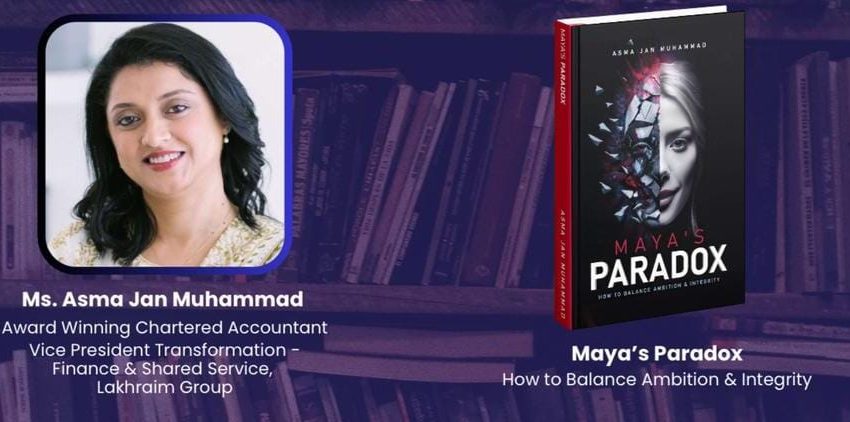
There are books that entertain, books that inform and then there are books that quietly hold up a mirror to the reader, asking questions we often avoid in the haste of our professional lives.
Asma Jan Muhammad’s Maya’s Paradox belongs unmistakably to the third category.
As a corporate lawyer accustomed to navigating dense corridors of policy, human behavior, and ethical nuance and as a fantasy writer constantly observing the human heart through metaphor and imagination — I found Asma’s third book to be a rare intersection where narrative simplicity meets moral depth, and where corporate realism is softened by emotional honesty.

A Portrait of Ambition, Integrity, and the Quiet Battles Within
Maya’s Paradox uses fiction not merely as storytelling, but as a reflective tool. Through over thirty vignettes, Asma introduces us to Maya — a hardworking professional carved from the same material as countless real individuals climbing the corporate ladder. But Maya is not a caricature of success, nor a flawless ideal. She is a paradox: deeply ambitious yet deeply human. Driven, yet principled. Tired, yet resilient.
Each short story becomes a snapshot of the thousands of unseen decisions modern professionals make:
• When is silence complicity?
• When is compliance wisdom, and when is it surrender?
• What does “success” truly cost and who pays for it?
These are not questions found in corporate policies, but in the folds of lived experience. Asma captures them with disarming clarity.
Short Stories that Echo Real Life
The book’s structure mirrors the rhythm of corporate reality brief, fast-moving episodes, punctuated by moments of self-reflection. From everyday office politics to moments of moral crossroads, each vignette feels familiar. At times it felt as though Maya was borrowing pages from my own professional journey, and from the journeys of colleagues, mentors, and young professionals I have guided.
The stories’ conclusions usually optimistic, often uplifting serve as small lanterns offered to readers navigating their own dimly lit dilemmas. Yes, some endings verge on idealistic, but perhaps that is precisely the hope our professional lives lack. The book reminds us that integrity is the foundation of true success. And in spheres where profit margins often overshadow moral margins, the reminder feels timely.
A Narrative that Engages Both Hearts and Minds
As a writer, I found the metaphorical layer of the book beautifully intentional. The title, Maya’s Paradox, is more than a name — it is a philosophical inquiry. Maya represents the modern professional: ambitious yet conflicted, competent yet reflective. The paradox is the balancing act we all perform — the attempt to reach upward without losing the grounding of our values.
As a lawyer, I appreciated the insights on leadership, ethical choice-making, and the resilience required to uphold integrity in environments where it is easier to compromise. The book doesn’t lecture; it invites the reader into an internal dialogue.
A Physical Book with Symbolic Depth
The cover, with its contrasting tones and clear visual language, is not mere decoration, it captures Maya’s duality, the tension between the world’s expectations and her inner compass. Thoughtful additions like the summary page and bookmark show Asma’s instinct for practicality a nod to the busy professional who seeks guidance at a glance.
It feels as if— this is a book one returns to. Some pages are not meant to be read only once; they are meant to be revisited in moments of doubt.
Asma Jan Muhammad’s Maturing Voice
Having previously encountered Reflections and S.H.O.R.E., I can say confidently that Maya’s Paradox reflects Asma’s most refined work yet. Her voice has matured still gentle, still empathetic, but now more pointed, more deliberate, more courageous in exploring the cracks within corporate life.
Her own statement “sometimes we must give our sincere viewpoints even if the consequences may not favor us” — becomes the spiritual thesis of the book. It is an uncomfortable truth, but a necessary one.
A Valuable Contribution to Corporate Ethics Literature
From a scholarly and professional standpoint, the book holds deeper value. Those interested in corporate ethics, leadership psychology, and narrative inquiry will find it both insightful and accessible. It bridges academic depth with human warmth — something not easily achieved.
Final Thoughts
Maya’s Paradox is not merely a collection of corporate tales; it is an invitation.
An invitation to pause.
To question.
To realign.
To remember that ambition and integrity were never meant to be opposites.
In a world urging us to run faster, Asma reminds us to walk straighter.
It is a book I would recommend to young professionals stepping into the corporate world, to seasoned leaders shaping workplace cultures, and to anyone who has ever wondered whether their values will survive the climb.
A thoughtful, sincere, and quietly powerful read.
I’m Haala Humayun, an advocate by profession, a fantasy novelist by heart, and someone who has always found refuge in stories. My journey with literature began long before I stepped into the courtroom or held a publishing contract; it grew quietly through the books I read, the worlds I imagined, and the desire to create something meaningful of my own.
Today, I write a fantasy series inspired by Middle Eastern and Persian folklore, weaving magic, emotion, and mythology into narratives that reflect the wonder I grew up seeking in books.
Alongside my own writing, I’ve developed a passion for reviewing works that speak to me stories that offer emotional resonance, depth, and a sense of purpose. Asma’s books fall beautifully into that space. I’ve reviewed several of her novels with the same honesty, detail, and heartfelt engagement that I apply to my own craft, because her writing deserves to be seen through a thoughtful lens.
My reviews appear on Goodreads and are often shared with literary platforms like Starthea for wider readership. Whether I’m drafting a chapter of my own saga or writing a review for an author whose work I admire, my aim is always the same: to honour the power of storytelling, to uplift meaningful voices, and to connect with readers through sincerity and imagination.