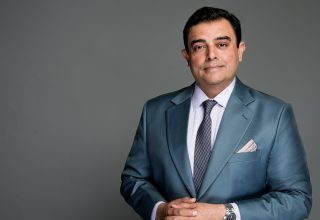
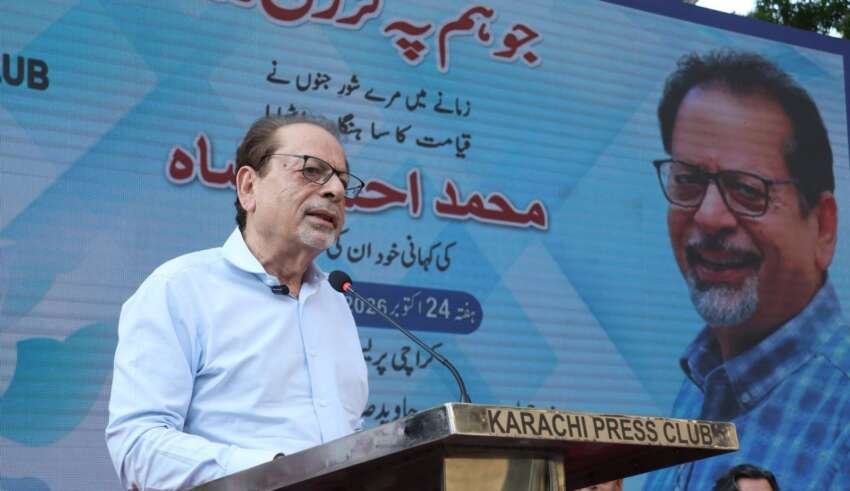
Preserving culture and identity is as important as protecting borders. When a society loses its culture, its foundations begin to weaken. — Muhammad Ahmed Shah
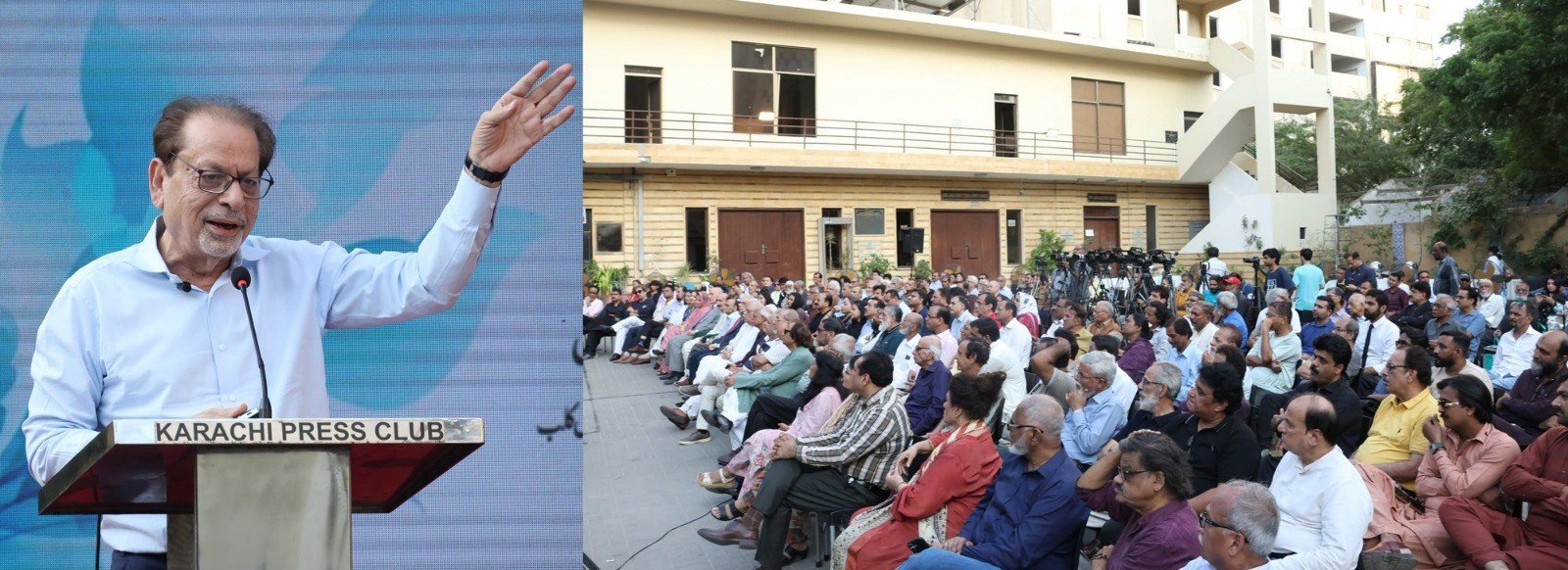
KARACHI: The Literary Committee of the Karachi Press Club organised a special evening in honour of Muhammad Ahmed Shah, President of the Arts Council of Pakistan Karachi, titled “Jo Hum Pe Guzri: Muhammad Ahmed Shah Ki Kahani, Khud Un Ki Zubani”. The event brought together Shah’s friends and associates to reflect on his personal journey, literary interests, theatrical activities and contributions to the promotion of arts and culture in Pakistan.
A showreel highlighting his literary and cultural services was also screened. Speaking on the occasion, Muhammad Ahmed Shah thanked Karachi Press Club President Fazil Jamili, Secretary Muhammad Aslam Khan and Literary Committee Secretary Javed Saba for organising the event. He shared various episodes from his life, tracing his journey from childhood and family background to his education, literary pursuits, association with the Karachi Press Club, involvement in theatre and leadership at the Arts Council.
Recalling his childhood in Nazimabad No. 4, Shah said that at the age of six, he had walked to school for the first time with his friends, carrying his schoolbag. He said the school held many memories for him, although a marriage hall now stands at its site. Recalling the 1965 war, he said his family would take shelter in trenches, while in the mornings they collected fragments from anti-aircraft guns. He also spoke about playing football with Baloch friends and forming a team called Lasbela Eleven. Shah said memories of childhood, one’s first teacher and the first day of school remained significant throughout life.
Speaking about his family history, he said his ancestors had migrated from Iran and settled in different areas. His father had a deep connection with religion and the Quran, helped people without expecting anything in return, and also had a keen interest in poetry. His recitation of Saif-ul-Malook and poetry inspired Shah’s own interest in literature.
He said his father’s upbringing had profoundly influenced his outlook on life. In his view, a person’s worth should be measured not by position, rank or wealth, but by character and knowledge. He expressed concern over growing class divisions and materialism, stressing that knowledge should be the true measure of distinction. Shah also recalled his father’s journey from his ancestral area to Lahore and later Bombay, where he began selling everyday goods near a cinema. His father’s experience, he said, reflected the importance of hard work, enterprise and self-confidence.
Describing his time at the University of Karachi as an important phase in his intellectual development, Shah said he had the opportunity to meet influential teachers, writers and friends. His circle included Faheem Zaman Khan, Shakeel Azhar Jafri, Haider Naqvi and Nusrat Mangi. Social gatherings, literary discussions and exchanges of ideas played an important role in shaping his outlook.
Shah said his association with the Karachi Press Club dated back to 1981 and that both the university and the Press Club had contributed significantly to his intellectual and personal development. During this period, he met prominent political figures, including Ghaus Bakhsh Bizenjo, Khan Abdul Wali Khan, Attaullah Mengal and Benazir Bhutto. He said he began reading Urdu literature in the eighth grade, while his meeting with poet Sabir Zafar in the ninth grade further drew him towards literary gatherings.
His association with writers and poets, including Sar Jamal Ehsani, Saleem Hashmi and Javed Saba, broadened his literary interests. He also recalled attending programmes featuring distinguished literary figures such as Shaukat Siddiqui and Ajmal Sultanpuri, as well as working with friends to improve facilities at the Karachi Press Club despite limited resources. Reflecting on General Zia-ul-Haq’s era, Shah said freedom of expression in the media was restricted and he opposed any environment that suppressed literature and creative expression.
He described open-mindedness as the ability to understand new ideas and examine them critically. Shah said that although he had initially wanted to pursue journalism, the low salaries offered in the profession at the time led him to explore other fields. However, his interest in journalism and intellectual discourse remained intact.
Discussing his association with theatre, Shah said he was among the founding members of a theatre group that included artists such as Hussain, Rahat, Yasmin Ismail and Sajid Hasan. The group introduced a series of four plays at Regent Plaza at affordable ticket prices, making theatre accessible to a wider audience. He said theatre also encouraged him to study English literature, philosophy and French theatre to develop a deeper understanding of his craft.
Emphasising the importance of young people, Shah said providing opportunities for emerging talent had always been one of his foremost priorities. He recalled hearing a young performer sing at the Arts Council and realising that talented children often needed only proper guidance and an opportunity to demonstrate their abilities. He said children from Lyari, Gadap and Orangi Town possessed immense potential, which could be nurtured irrespective of religion or community background. He described the students of the Arts Council’s art school as a testament to this vision.
Paintings by children from Lyari, Lalukhet and Orangi Town were being exhibited in Ireland and Canada, giving the young artists recognition, confidence and opportunities to transform their lives. Having experienced social and economic challenges himself, Shah said he understood the difficulties faced by young people from underprivileged backgrounds. Recalling the transformation of the Arts Council, Shah said the institution initially received an annual grant of only Rs1 million. He and his colleagues worked to amend its constitution, introduce elections and provide representation to different individuals and groups. He stressed that their objective was not merely to secure positions but to strengthen the institution and create opportunities for others. Shah said the International Urdu Conference was launched in 2008 when resources were extremely limited.
Guests arriving from outside Karachi were accommodated in guesthouses and the homes of friends, while an old van was used to transport them. Despite the challenges, the conference gained media attention and helped establish the Arts Council’s standing as a significant platform for Urdu literature and intellectual exchange. He said the success of the International Urdu Conference encouraged him to pursue further initiatives, including youth festivals, literary festivals and other cultural activities. Through the Pakistan Literature Festival, programmes were organised in different cities to promote literature and culture. He described the World Culture Festival as another achievement of collective effort, driven by young people from diverse linguistic and ethnic backgrounds.
Shah revealed that he had received death threats at one stage but continued his efforts to protect the institution and strengthen its cultural role. He said writers, poets and intellectuals had supported him in preserving Pakistan’s literary and cultural traditions. He added that his vision was to take art and culture to every part of Pakistan. In line with this commitment, arts councils were established in Sukkur, Larkana, Mirpurkhas and Khairpur, where children were being introduced to the fine and performing arts and music. He emphasised that all Pakistani languages, regions and cultures deserved equal representation.
Reflecting on the personal sacrifices associated with his work, Shah said his greatest wealth was not money or material possessions but the people who valued his efforts. He had devoted much of his life to the Arts Council and the promotion of culture, leaving limited time for his family and children. His wife had shouldered much of the responsibility for raising their children. He also acknowledged that prolonged pressure had affected his health, but considered these challenges part of his commitment to the cause.
Shah stressed that preserving culture and identity was as important as protecting national borders, warning that a society that lost its cultural identity risked weakening its foundations. He described the transformation of the Arts Council and the expansion of its activities as the result of collective struggle and dedication. He further described the Karachi Press Club as an important platform for freedom of opinion and dialogue, emphasising that strong institutions required unity and that disagreements should be resolved through discussion rather than hostility.
Concluding his remarks, he thanked the Karachi Press Club’s office-bearers and his friends for their continued support, reiterating that hatred could not resolve problems and that dialogue remained the most effective way to overcome differences. Earlier, Karachi Press Club President Fazil Jamili said Muhammad Ahmed Shah’s achievements and standing were widely recognised. He recalled that the Arts Council’s activities had once been limited and the institution would close its doors in the evening. Shah, however, had transformed it into one of Pakistan’s leading cultural centres and established its identity internationally.
Jamili added that the Karachi Press Club had always been a home for Shah and had awarded him lifetime membership in recognition of his literary and intellectual contributions. He said the “Jo Hum Pe Guzri” series was designed to explore the life journeys of distinguished individuals, from their childhood to their present standing, including the hardships, deprivation and disappointments they had experienced along the way. Karachi Press Club Secretary Muhammad Aslam Khan said Shah needed no introduction. Despite the difficult circumstances in Karachi, he had continued to promote theatre and cultural activities and played a significant role in strengthening the city’s cultural identity.
Khan said the World Culture Festival had brought international recognition to Karachi and Pakistan, while Shah’s literary and cultural contributions, particularly the International Urdu Conference, remained noteworthy.