By Rafiq Vayani
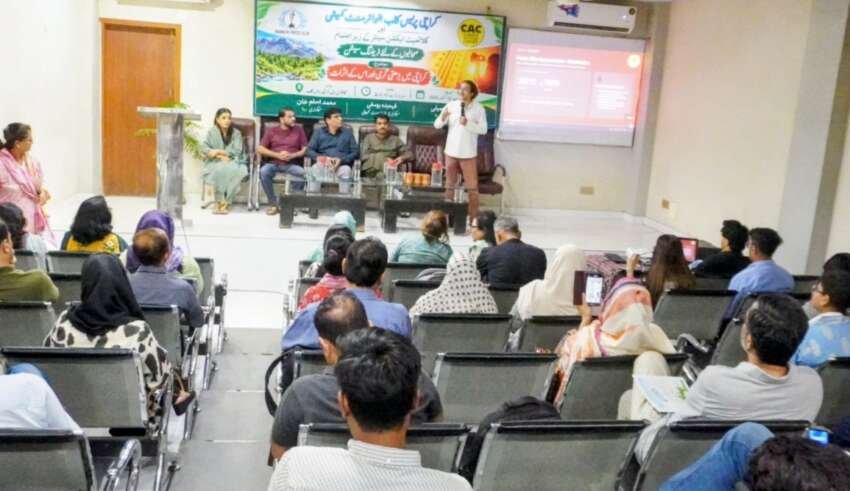
KARACHI: The Karachi Press Club Environment Committee and the Climate Action Center Karachi (CAC) held a joint training session for journalists and media professionals titled “Extreme Heat, Climate Change & Karachi” at the Karachi Press Club today. The session was among the Committee’s early initiatives and drew a full house.
Led by Yasir Husain, Director of the Climate Action Center Karachi, the three-hour session aimed to help reporters cover extreme heat more accurately and in more depth. It was attended by Fahmida Yusuf, Secretary of the KPC Environment Committee, Fazil Jamili, President of the Karachi Press Club, and Aslam Khan, Secretary of the Karachi Press Club.
Speaking about the Committee’s decision to organize the session, Fahmida Yusuf said: “An initiative like the KPC environment committee has never been undertaken, but such is the crisis that we at the Karachi Press Club felt the need to step forward and provide a platform to a much needed conversation, which is how we ultimately came to arrange this session.”
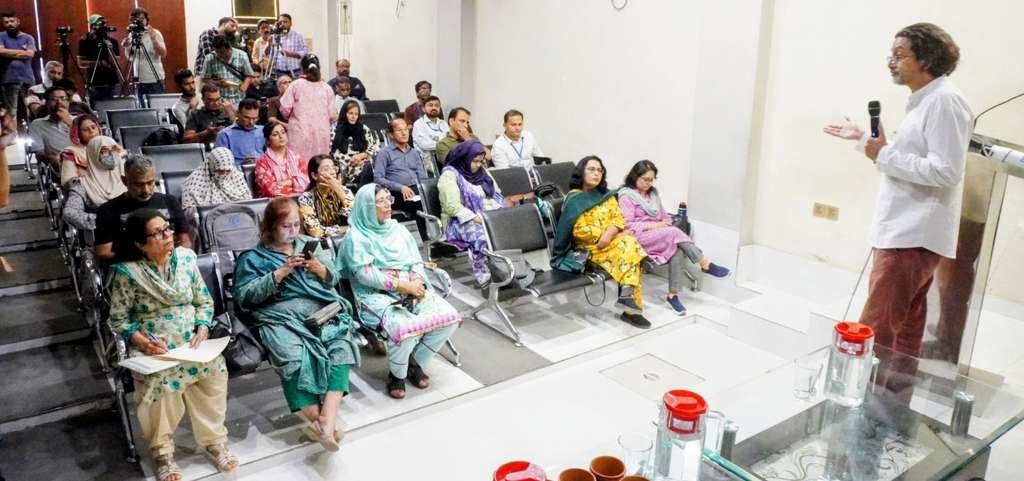
The sole speaker, Mr. Husain began with the basics, explaining how humidity changes the way heat affects the body. For example, an air temperature of 35°C with 70% humidity can feel closer to 50°C. He then covered the role of El Niño, the seasonal pattern of heat and humidity in Karachi, and the links between extreme heat, water stress, agriculture and the shrinking Indus Delta.
“Climate change is a corporate term. Change can be good or bad. We are in a state of climate emergency, this is a climate crisis,” Mr. Husain said. “Unfortunately, we have not seen dialog or response to match the scale and magnitude of the emergency, which is why we held this training in the first place.”
Participants also reviewed research on the city. This included heat-vulnerability maps from the Karachi Climate Action Plan and thermal imaging of buildings by Dr. Jameel Kazmi. They also discussed Aga Khan University’s heat-adaptation trials in Karachi and Matiari, which test reflective roof coatings, ventilation and roof shading. Karachi Urban Lab data shows daytime temperatures in the city rising by 1.6°C and nighttime temperatures by 2.4°C over 60 years.
The session also addressed energy poverty, noting that some Karachi localities face up to 10 hours of daily load-shedding, which leaves residents with less cooling during heatwaves. It looked at energy-efficient building design, including ECBC 2023 and SBCA bylaws, before turning to the Karachi Cooling Plan. Developed with PMD, the health sector, civil society, academia and urban experts, the plan includes strengthened early warning systems, 10,000 urban forests, heat resilience in the Karachi Master Plan 2047, heat-ready healthcare, community cooling centers and affordable cooling solutions.
Journalists asked enthusiastic questions towards the end, and Mr. Husain answered them at length, on topics including heatwaves and public health and the impact on outdoor workers, women, children and the elderly.
The Karachi Press Club Environment Committee and the Climate Action Center said they will continue working together to strengthen climate reporting in Pakistan.
rafiq@biztoday.news