
By Rafiq Vayani
KARACHI: Karachi Council on Foreign Relations (KCFR) organized a high-level public debate on “Rethinking Governance in Pakistan” here, earlier today.
The programme brought together prominent political leaders, policymakers, parliamentarians, academics, and analysts to deliberate on Pakistan’s governance systems and the institutional, political and administrative challenges affecting governance in the country.
The discussion centered on the need to reassess existing governance structures, strengthen institutions, improve coordination between federal and provincial governments, enhance accountability and transparency, and develop systems that are more responsive to citizens’ needs.
Renowned philanthropist and Chair KCFR, Nadira Panjwani stressed on the urgent need for institutional accountability, sustainable development, and human-centered policy making. Panjwani stressed that governance is not merely an exercise in administration, it is a moral commitment to the well-being and dignity of every citizen.
Distinguished analyst and host of Global Sach, Dr Nasir Baig, framed the core issue around structural trust, social digital transformation and empowerment of the ordinary citizen. He said that Pakistan’s greatest strength is the resilience and labour of its citizens. Dr. Baig noted that meaningful governance reform requires genuine, selfless intent rather than short-term calculation, and cautioned against restructuring decisions made without accounting for the country’s changing needs over time.
Imran Ismail, former Governor of Sindh, addressed the structural obstacles to effective public administration, emphasizing political reform and fiscal decentralization. He drew attention to the limited powers afforded to Karachi’s local government compared to city leadership elsewhere in the world, and called for stronger accountability at senior levels of administration.
Dr. Farooq Sattar underscored that Pakistan’s 80-year journey has reached a point demanding long-avoided structural reforms, calling for a more participatory model of democracy. He noted that Pakistan’s population has long outgrown the scale of representation offered by its current elected bodies, and pointed to Karachi’s significant untapped economic potential, describing the present moment as a critical opportunity to strengthen investor confidence.
Former Prime Minister, Shahid Khaqan Abbasi proposed diverse perspectives on Pakistan’s political and administrative landscape, with particular emphasis on institutional reform, democratic governance, public service delivery and more accountability. He cited Pakistan’s neonatal mortality rate as among the worst globally, and called for stronger implementation of the rule of law alongside genuine institutional reform.
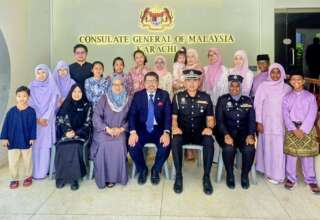
The seminar was attended by prominent political and diplomatic figures, along with foreign delegates including representatives from Russia, the United States, and the Consul General of Bangladesh. A special group photo session was held with students from the Ida Rieu Welfare Association, an institution for the visually impaired and deaf, along with the speakers.
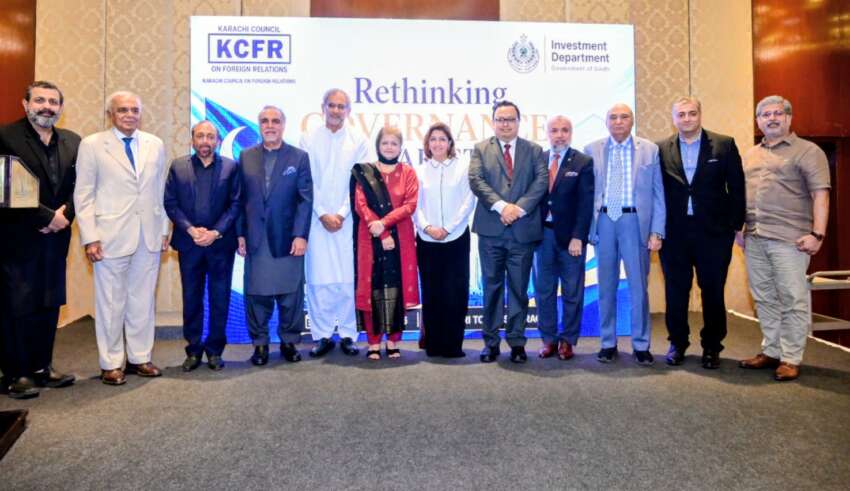
Board of Governors members of KCFR also joined the speakers for a photo session, followed by the presentation of mementos to Dr. Nasir Baig, Imran Ismail, Dr. Farooq Sattar, and Mr. Shahid Khaqan Abbasi by KCFR Chairperson Nadira Panjwani.
The seminar concluded with a group photograph of the speakers, guests, and delegates, marking the end of an engaging and thought-provoking session on the future of governance in Pakistan.