
By Dr. Abdullatif Alshanqiti, Associate Editor, ORL-H&N Surgery
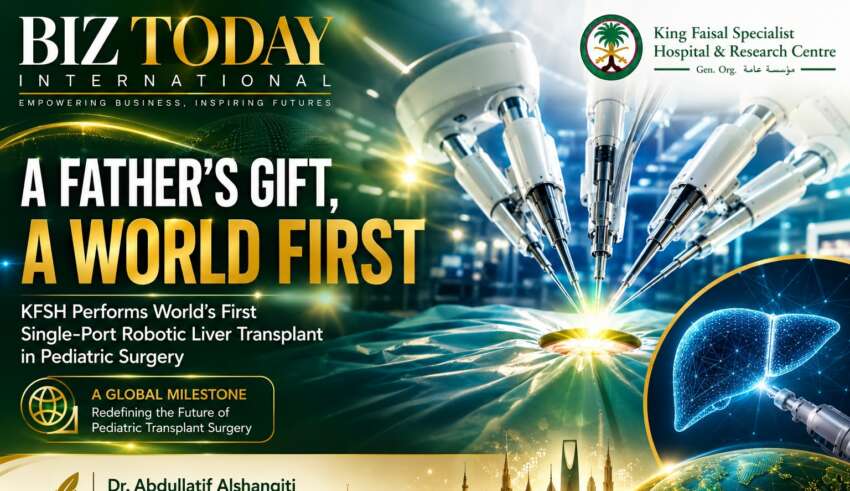
In a landmark achievement that advances the future of pediatric transplantation, King Faisal Specialist Hospital and Research Centre (KFSH) has successfully performed what it describes as the world’s first pediatric liver transplant using a single-port robotic system, marking a new chapter in minimally invasive surgery and robotic transplantation.
The historic procedure was performed on a six-year-old boy who had endured recurrent episodes of acute liver failure. His father became the living donor, providing part of his liver in a life-saving act that enabled surgeons to combine medical innovation with extraordinary family commitment. The transplant was completed through a single robotic incision, significantly reducing surgical trauma while preserving the precision required for one of medicine’s most technically demanding operations.
Unlike conventional robotic liver transplantation, which requires multiple access ports, the single-port platform enables surgeons to operate through a single entry point while maintaining high-definition visualization and advanced instrument control. This approach has the potential to reduce postoperative pain, improve cosmetic outcomes, and support faster recovery without compromising surgical accuracy.
The achievement builds upon KFSH’s expanding leadership in robotic transplantation. Earlier this year, the institution reported the world’s first fully robotic living-donor liver transplant and subsequently introduced the first series of single-port robotic living-donor liver resections, reflecting a sustained strategy to expand minimally invasive techniques across increasingly complex transplant procedures.
Beyond its technical significance, this milestone demonstrates how robotic innovation is reshaping pediatric organ transplantation by making highly complex procedures less invasive while maintaining the rigorous standards required for donor and recipient safety. It also highlights the growing role of advanced robotic platforms in improving surgical precision and enhancing patient-centered care.
As robotic surgery continues to evolve, achievements such as this reinforce Saudi Arabia’s growing contribution to global surgical innovation. By combining cutting-edge technology, multidisciplinary expertise, and compassionate care, King Faisal Specialist Hospital and Research Centre continues to push the boundaries of what is possible in modern transplantation, offering new hope for children with life-threatening liver disease and setting a benchmark for the future of minimally invasive pediatric surgery.