
News Desk
DUBAI: When thinking of the best tablet displays, what comes to your mind? The size, brightness, colour depth, and so on, of course. These are indeed the numbers to look for, and they do profoundly affect the tablet experience. But great displays are about more than just specifications. One key aspect that is often overlooked is visual comfort. With tablets becoming devices that people use for hours rather than minutes, visual comfort has become a priority. Students, especially, rely on tablets throughout the day for note-taking, online lectures, course materials, and sketching. As a result, visual comfort has become non-negotiable.
Paper-like comfort: Anti-glare technology is not new to the tablet industry. But Huawei has a fundamentally different approach to it. Huawei introduced the world to paper-like displays with its self-developed PaperMatte Technology, which was a marked improvement from traditional anti-glare glasses. Unlike PaperMatte, traditional anti-glare glass relies on sandblasting techniques that lack precision in controlling etch patterns and durations, leading to irregularly sized and spaced nanostructures.
These haphazard microstructures act like fragmented glass shards at the microscopic level, scattering incoming light chaotically across the surface. This uncontrolled dispersion creates uneven bright spots and colour variations, disrupting visual clarity and compromising the overall display quality. Unlike these regular matte-textured screens, Huawei uses advanced photolithography techniques, introducing a high-precision nano-level etching process, delivering an unparalleled crystal-clear viewing experience.
Huawei’s PaperMatte Display OLED technology is designed to reduce glare by diffusing reflections and creating a more paper-like picture quality. Nano-level etching technology lies at the heart of the PaperMatte Display’s anti-glare innovation. Hundreds of billions of microscopic textures are meticulously etched onto the screen’s surface. This diffuses both direct and indirect light evenly, drastically reducing eye strain caused by ambient glare, far surpassing traditional glossy screens and emphasising long-term visual comfort.
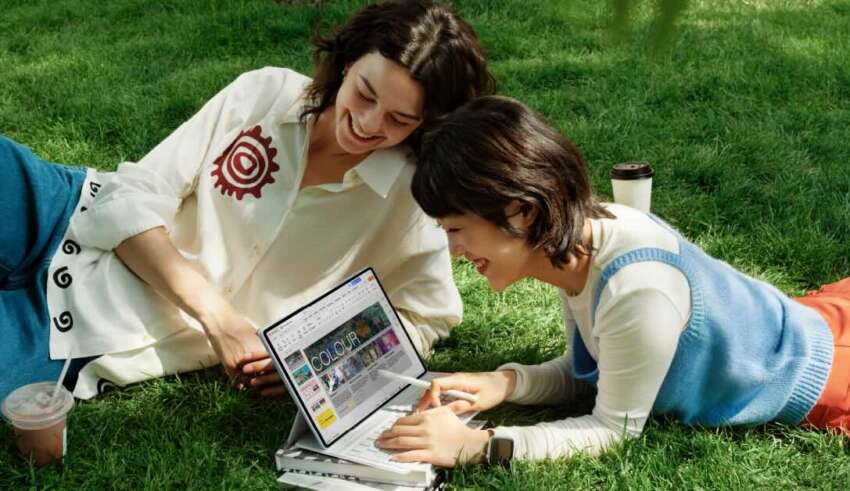
Making digital feel natural: Display comfort addresses one aspect of digital fatigue. Interaction is another. As tablets take on tasks once reserved for pen and paper, Huawei is bringing the natural feel of paper to digital writing. The AI handwriting feature on HUAWEI Notes and the advanced M-Pencil Pro have made pioneering headway in this area, with features such as pressure sensitivity, low-latency connectivity, and intuitive gestures helping digital writing feel more like interacting with a familiar tool. The M-Pencil Pro takes advantage of faster low-latency connectivity to make writing and drawing feel more seamless than ever.
Tablets are moving from secondary screens to becoming primary gadgets, and the manufacturers gaining ground are those who understand that the device itself should increasingly get out of the way.
Huawei’s latest MatePad innovations reflect many of the broader trends reshaping the category. As tablets evolve from secondary devices into platforms for work, learning, and creativity, the most important question may no longer be how powerful a tablet is, but how effortlessly it helps people create, focus, and get things done.