

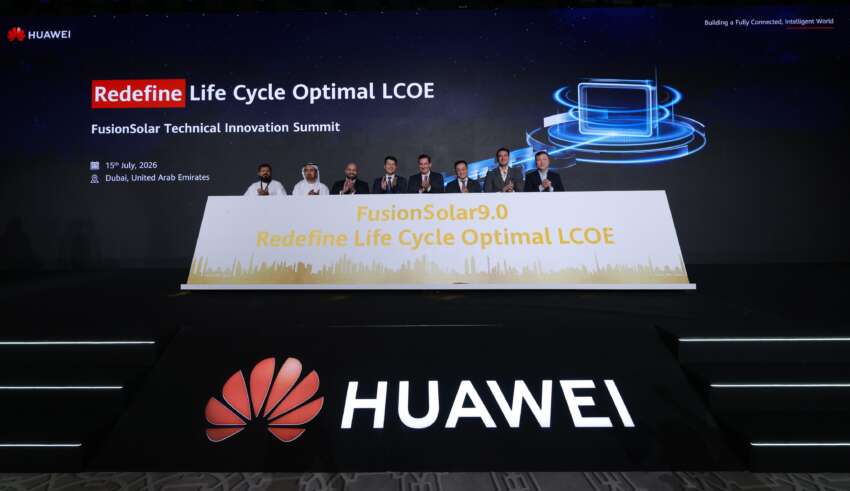
DUBAI: Huawei Digital Power, a leading global provider of solar and renewable energy technology, successfully hosted the FusionSolar Technical Innovation Summit in Dubai on July 15 to address the critical grid-stability challenges facing the Middle East and Central Asia’s rapidly growing renewable energy sector. The event gathered industry leaders, policymakers, technology experts, utilities, EPCs, developers, consultants, and partners from across the Middle East and Central Asia (ME&CA) to witness the regional launch of the next-generation FusionSolar 9.0 Smart PV Solution. The summit examined the technologies shaping the next generation of solar power and the evolving requirements of increasingly renewable-powered grids.
The event opened with a welcome address by Mr. Alex Xing, President of Huawei Digital Power Middle East & Central Asia, who emphasised that as renewable energy deployment accelerates across the region, the industry’s focus is shifting beyond capacity expansion towards building power systems that are smarter, more resilient and better equipped to maintain grid stability.
“The Middle East and Central Asia are entering a new phase of renewable energy development, where reliability, grid stability, and intelligent digital technologies are becoming just as important as efficiency. Huawei remains committed to continuous innovation and close collaboration with our customers and partners to build resilient, intelligent, and sustainable energy systems. The launch of FusionSolar 9.0 demonstrates our commitment to supporting the region’s energy transition with technologies that deliver greater value throughout the entire lifecycle of solar power plants,” said Alex Xing, President of Huawei Digital Power Middle East & Central Asia.
As part of a dedicated session at the summit on Future Trends & Challenges, Aleksi Lumijärvi from IRENA shared insights into renewable energy development trends across the Middle East, highlighting the growing role of 24/7 renewable energy systems and dispatchable clean power in supporting future electricity demand. Representing RIT University Dubai, Dr. Abdulla Ismail discussed the UAE’s renewable energy strategy and the complexities of integrating larger volumes of renewable generation into the national grid. Nofel Dakhel from SJ Group presented Oman’s renewable energy roadmap, highlighting the country’s ambitions and opportunities to accelerate clean energy deployment.
A major highlight of the event was the regional launch of the Huawei FusionSolar 9.0 Smart PV Solution, presented by Zhang Xingzhong, Huawei. Developed for the evolving demands of utility-scale solar projects, FusionSolar 9.0 integrates next-generation string inverter technology, enhanced grid-forming capabilities, intelligent digital management and improved reliability to help developers build more stable, efficient and intelligent power systems.
The session also featured real-world case studies by Huawei, illustrating the solution’s application across major renewable energy projects. A representative from PowerChina HDEC, Saleh El Haj Youssef, shared key design insights for string inverter applications and highlighted the value delivered in ADQ projects. The EDF team, represented by Antonio Diaz, shared practical lessons learned from the UAE PV3 project, demonstrating how Huawei’s string inverter architecture improves plant performance, simplifies system design and optimizes long-term lifecycle value.
Independent experts validate grid-forming technology
The technical sessions focused on maintaining power system stability as renewable energy penetration continues to increase. Dr. Carlos Alvarez from Huawei presented the latest advancements in grid-forming (GFM) technology, including simulation studies conducted in Saudi Arabia, validation testing in Germany and newly published independent technical assessments.
The summit concluded with the Third-Party Consulting Report Release Ceremony, during which Nikola Djeric, Associate Director at Go2Power provided an independent evaluation of Huawei’s grid-forming capabilities for string inverter solutions, while Pranav Patel, Team Lead Solar Technology and Analytics Southern Europe, Middle East, Africa and Latin America (SEMELA) at DNV, shared an assessment of long-term string inverter performance and reliability. Both entities unveiled independent technical reports validating Huawei’s grid-forming capabilities and the long-term performance of its technologies.
By combining intelligent digital technologies with advances in Smart PV and grid-forming innovation, Huawei Digital Power continues to support the development of more resilient, efficient and low-carbon energy infrastructure, helping countries across the region accelerate their energy transition and long-term sustainability ambitions.