
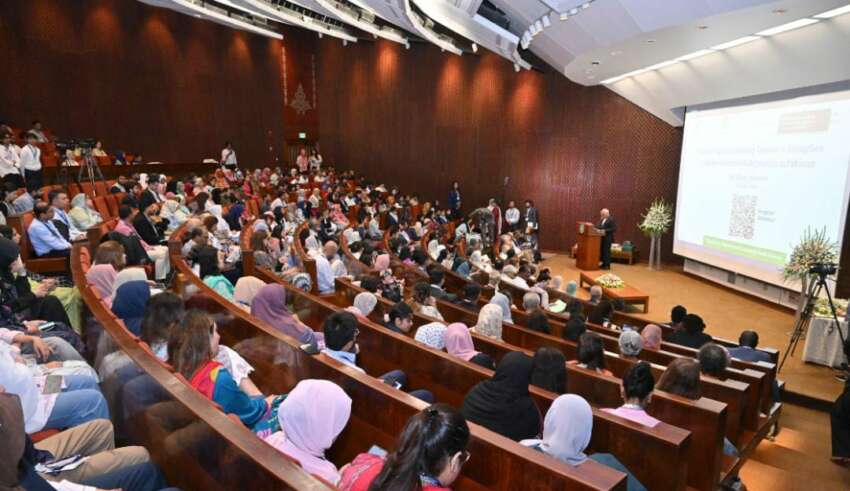
KARACHI: Federal and provincial health leaders joined global experts in Karachi this week to press for a shift toward evidence-informed and technology-driven health policymaking in Pakistan, with policymakers, researchers, development partners, academia and global health experts calling for artificial intelligence and stronger delivery systems to improve care.
The call came at a two-day symposium organised and hosted by the Aga Khan University (AKU), in collaboration with Exemplars in Global Health and Results for Development (R4D), which examined how policy lessons from countries including Kenya, Malawi, Bolivia and Senegal could be adapted to Pakistan.
The cross-country evidence highlighted that progress is achieved through a combination of factors rather than a single intervention. Key themes included sustained political commitment, supportive policy environments, increased domestic investment, strengthened health systems, availability of a wider range of contraceptive methods, community engagement, partnerships with non-governmental organizations and the effective use of data to guide decision-making. These are all lessons that can be applied to Pakistan.
Despite gains over the past two decades, Pakistan’s maternal mortality ratio remains at 186 deaths per 100,000 live births, a decline of 33% since 2007, according to a 2025 report in PLOS One. This is combined with the alarming statistic that a woman in Pakistan dies from pregnancy-related complications roughly every 50 minutes, according to UNFPA Pakistan. The scale of the challenge underscored the urgency behind the symposium’s call for evidence-informed reform.
A recurring theme was that effective policy emerges through sustained collaboration between researchers, governments and implementers. Participants examined knowledge translation, adolescent reproductive health, implementation challenges and the role of universities in embedding evidence into policy and practice.
Dr Zahid Memon, the symposium’s convener and Section Head, Health Policy and Management at AKU’s Community Health Sciences Department said, “the objective is not simply to exchange ideas, but to identify actionable lessons. Improving health outcomes in Pakistan begins with improving the quality of our services and strengthening the systems that deliver them through innovative approaches including artificial intelligence.”
“People should be at the centre of development as evidence without impact doesn’t have much significance,” said Dr Muhammad Amjad Saqib, Founder and Chairman, Akhuwat, pointing to the importance of economic development in improving lives: “Akhuwat has disbursed $1.8 billion in interest-free loans, helped 4 million families, and maintained a 99% recovery rate – a figure that speaks to the credibility of people.”
The event also drew family planning experts from Kenya, Malawi, Bolivia, Senegal and Sierra Leone, alongside leading academics from Australia, Canada and the United Kingdom, underscoring the cross-country learning at the heart of the meeting.
Distinguished participants included, Mujeeb-ur-Rehman, Secretary Health, Government of Balochistan, Hafeezullah Abbasi, Secretary, Population Welfare Department, Sindh, Zafar Buledi, Secretary, Population Welfare Department, Government of Baluchistan, Talib Lashari, Population Welfare Department, Government of Sindh, Dr Amjad Saqib, Founder and Chairman, Akhuwat, Dr Najam Shah, Chair Planning & Development Department, Government of Sindh, Dr Safi Malik, Health Advisor, Ministry of National Health Services, Regulations and Coordination, Government of Pakistan, Mr Irshad Sodhar, CEO, Sindh Social Protection Authority, Ms Nida Khuhro, Parliamentary Secretary for Health and Population Welfare, Government of Sindh, Taimur Jhagra, former Minister for Finance and Health, Khyber Pakhtunkhwa, Professor Seye Abimbola, University of Sydney and former Editor-in-Chief, BMJ Global Health, Professor Ali Cheema, Vice-Chancellor, Lahore University of Management Sciences, Professor Shahzad Ali, Vice Chancellor, Health Sciences Academy, Dr James Blanchard, Executive Director, Institute for Global Public Health, University of Manitoba, Canada and Dr Zohra Lassi, Associate Professor, University of Adelaide, Australia.