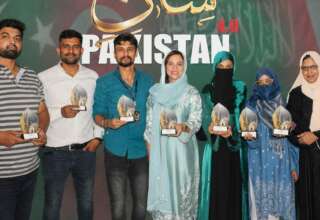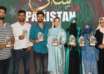

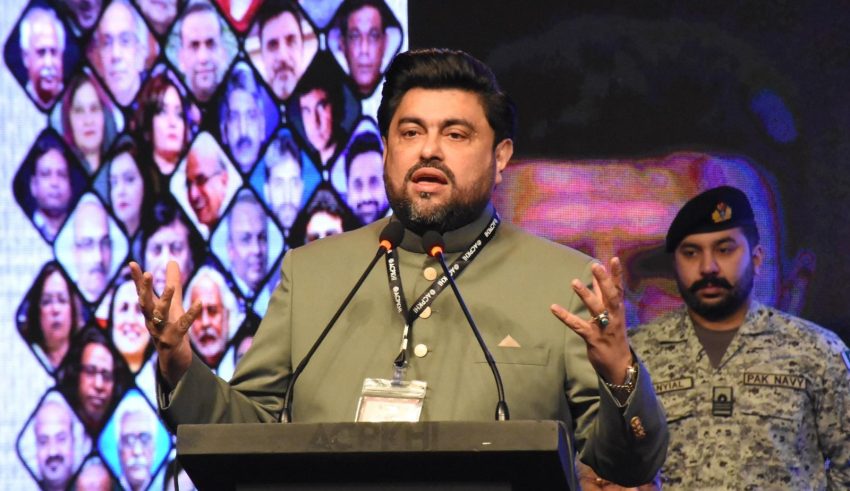
KARACHI: Arts Council of Pakistan Karachi inaugurated the four-day “18th Aalmi Urdu Conference 2025 – Jashan-e-Pakistan.” Governor Sindh Kamran Khan Tessori attended the opening ceremony as the chief guest, while President Arts Council Muhammad Ahmed Shah warmly welcomed all the guests.The opening ceremony commenced with the recitation of the Holy Quran, followed by the national anthem, after which a show reel prepared on the Aalmi Urdu Conference was presented.
A large number of people, including students, were present in the hall during the “18th Aalmi Urdu Conference 2025 – Jashan-e-Pakistan.” On this occasion, cakes were also cut to mark the birth anniversary of Quaid-e-Azam Muhammad Ali Jinnah and Christmas. Renowned poet Iftikhar Arif, Asad Muhammad Khan, Peerzada Qasim Raza Siddiqui, Noor-ul-Huda Shah, Mustafa Qureshi, Tariq Rafi, Asghar Nadeem Syed, Hafeez Khan, Sarwat Mohiuddin, Ejaz Farooqi, Huma Mir, Nasir Abbas Nayyar, Yousuf Khushk, Mazhar Abbas, Munawar Saeed, Ghazi Salahuddin, Adal Soomro and senior journalist Suhail Warraich were among those present at the inaugural session.President Arts Council Muhammad Ahmed Shah delivered the welcome address, while renowned writer and critic Nasir Abbas Nayyar presented the keynote address.

This year, the theme of the 18th Aalmi Urdu Conference has been set as “Jashan-e-Pakistan.” On the occasion, the auditorium echoed with slogans of Pakistan Zindabad. Addressing the opening ceremony, Governor Sindh Kamran Khan Tessori said that Karachi is called Mini Pakistan, and the soul of Mini Pakistan is the Arts Council. He said that the person who infused spirit into the Arts Council is Ahmed Shah, and Allah has bestowed him with the ability to do this work. He said that this country is scattered like a broken garland, and our desire is to unite everyone. He expressed happiness that the process of uniting people has begun through the Aalmi Urdu Conference. He said that Urdu is a link language and that we are proud that Urdu is the language of this region. He stated that 150 to 160 million people in this country speak Urdu.
He added that during this four-day Aalmi Urdu Conference, discussions are held in Siraiki, Pashto, Kashmiri, and other languages as well. He said that in a living society, along with doctors and engineers, writers and musicians are also essential. The Governor said that the Urdu Conference has provided a path for the coming generation, and we must reflect on what we can do for our language. He said that over eighteen years, Ahmed Shah has turned this into a strong event. He added that the Arts Council organized the World Culture Festival, which was not limited to Pakistan alone but involved 142 countries. He said that the year 2025 is nearing its end, and today marks both the birth anniversary of the Father of the Nation and Christmas. ALLAH has given us this country. One can fight with power, and in 2025, we defeated an enemy five times larger than us.
Pakistan’s armed forces proved that when the entire nation stands together, it can defeat a stronger enemy. He said that Ahmed Shah is highlighting all cultures and bringing people together. He added that the future of this country’s youth lies in our hands. He said that those shown in the show reel have no parallel; everyone has fulfilled their role and moved on.
President Arts Council Muhammad Ahmed Shah, in his welcome address, thanked everyone and said that the Urdu Conference is a galaxy where Pakistani writers, poets, artists, and actors gather. He said that when he arrived in this city 20–25 years ago, there was no such institution. After the partition of the subcontinent, major figures of literature, music, and arts migrated here from all over, but unfortunately, there was no institution dedicated to literature and culture.
He said that he believes his elders who passed away were blessed souls, including Mushtaq Ahmed Yousufi, Fatima Surayya Bajia, Jameel Uddin Aali, Jameel Jalibi, Aslam Farrukhi, and Farman Fatehpuri, among others. He said that every major Indian writer participated in this conference. He recalled that Dr Zia-ul-Hasan and his wife, Hameeda Shaheen, would receive visiting literary figures at Wagah Border and take them to their homes before bringing them to the conference. Writers such as Intizar Hussain, Abdullah Hussain, Hameed Akhtar, Nasir Kazmi, and Saleem Akhtar were also brought. He said that these individuals are the bright lamps of our society, and sessions are also being held on the centenaries of Jameel Uddin Aali and Intizar Hussain. He said that the 18th Aalmi Urdu Conference has been named “Jashan-e-Pakistan.” He added that as an institution of art and culture, they are celebrating all those who fulfilled their responsibilities and departed, including painters, musicians, singers, actors, and directors.
He mentioned names ranging from Salimuzzaman Siddiqui to Sadequain, Zahoor-ul-Akhlaq to Shakir Ali, and Anwar Jalal Shemza to Colin David, saying that whether they came to this country or belonged here, they advanced the arts. This conference, he said, is a tribute to all of them. He said that Peerzada Qasim Raza Siddiqui, Iftikhar Arif, Professor Sahar Ansari, and Fatima Hasan have been with them since the very first day. When the Urdu Conference began, there was not a single rupee, yet it became the largest conference, lasting seven days, with participants from across the world.
Karachi’s residents opened their doors, hosted guests in their homes, some stayed in Karachi University hostels, and some tickets were purchased by the citizens themselves. He said that the entire city collectively laid the foundation of such a grand global conference. There were no buildings or funding, only passion. Figures such as Nabi Bakhsh Baloch, Shemir Haidari, Dr Siraj-ul-Haq Memon, Agha Sahib, and others participated. Sobho Gianchandani and Hajra Masroor were part of the very first conference. He said that they took up the responsibility of the Urdu Conference at a time when the city was engulfed in hatred, and hundreds were being killed.
They felt someone had to speak of love. He said that while swords and guns have power and can kill instantly, the power of literature, songs, arts, and the notes of a sitar have a lasting impact. These were the only weapons they possessed. He said he has no words except gratitude and thanked the city, the country, and Quaid-e-Azam Muhammad Ali Jinnah for giving them a country where they can breathe freely, express themselves, dance, and sing. He said that today marks Quaid-e-Azam’s birth anniversary and that unity should be centred on three things: Pakistan, Pakistan’s flag, and Pakistan’s founder Muhammad Ali Jinnah. He also congratulated the Christian community on Christmas and said this day is for renewing commitment and loyalty.
He said that while celebrating, we cannot forget the sacrifices of Quaid-e-Azam, Liaquat Ali Khan, Allama Iqbal, and others. Through the media, he urged people to attend the conference, calling it a celebration of culture and literature, and encouraged families to bring their children.Renowned poet Iftikhar Arif said that the Arts Council invites speakers of all Pakistani languages to the Urdu Conference. He said he has been attending for eighteen years, and writers from all languages strengthen the tradition of dialogue. He said that anyone who loves their mother tongue cannot hate another’s language.
He said that no one has suffered more than us on the issue of language, and now is the time to reflect and think. In his keynote address, renowned writer and critic Nasir Abbas Nayyar said that literature not only creates new styles, themes, and languages, but also creates new spaces. He said that if literature cannot create a new era, it highlights the decay of the old one, and in such times, literature and the arts come to humanity’s aid.He said that fire is of two kinds: external and internal.
By organizing a global cultural festival a few days ago, Ahmed Shah created a new space that can be called a Global Dialogic Space, where arts of theatre, film, painting, music, and dance from more than 100 countries interacted with one another. He said that while literature and arts possess local identity, their dialogue extends to the entire world. Literature is both a tree and a bird, he said, adding that our literature needs a global dialogic space.