
By Rafiq Vayani
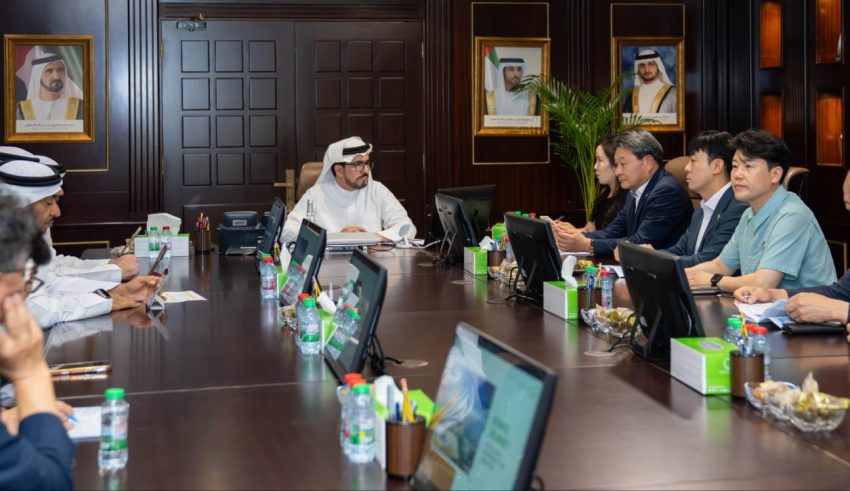
DUBAI: HE Saeed Mohammed Al Tayer, MD & CEO of Dubai Electricity and Water Authority (DEWA), welcomed a high-level delegation from South Korea’s Incheon Metropolitan Council, headed by Councillor Chairman Kim Yoo Kon. The meeting focused on strengthening co-operation in renewable energy, sustainability and smart infrastructure.
The visit served as a strategic opportunity to benchmark Dubai’s pioneering energy transition initiatives and explore avenues for mutual collaboration. The Korean delegation received a comprehensive briefing on DEWA’s vision and its ambitious road map to increase the share of clean and renewable energy in Dubai’s energy mix.
Al Tayer highlighted DEWA’s flagship projects, including the Mohammed bin Rashid Al Maktoum Solar Park – the world’s largest single-site solar part based on the independent power model, with a current production capacity of 3,860 MW – and the pioneering Green Hydrogen project, the first of its kind in the MENA region to produce hydrogen using solar power. He emphasised the importance of international knowledge exchange, in line with Dubai’s commitment to fostering global partnerships to accelerate the transition to a sustainable green economy.
Al Tayer shared DEWA’s expertise in developing climate-resilient infrastructure, such as the 250 MW Hatta Pumped Storage Hydroelectric Power Plant, the first of its kind in the GCC. The project will use water stored in Hatta Dam to generate electricity on demand and enhance grid stability and energy security.
The meeting explored policy strategies for advancing sustainable urban development, with DEWA showcasing its smart infrastructure leadership across its entire generation, transmission and distribution networks, which use artificial intelligence and data analytics to predict faults and optimise performance. Discussions also covered DEWA’s self-healing smart grid and its intelligent water and electricity networks that provide customers with real-time data to promote efficiency of consumption.
The delegation visited the Mohammed bin Rashid Al Maktoum Solar Park – a cornerstone of the Dubai Clean Energy Strategy 2050 and the Dubai Net Zero Carbon Emissions Strategy 2050 – where they gained firsthand insight into the immense scale of the project and its groundbreaking technologies, including bifacial panels and solar-tracking systems.
The Incheon delegation also shared insights into South Korea’s green energy and smart grid policies, identifying potential synergies to building future-proof, sustainable cities.