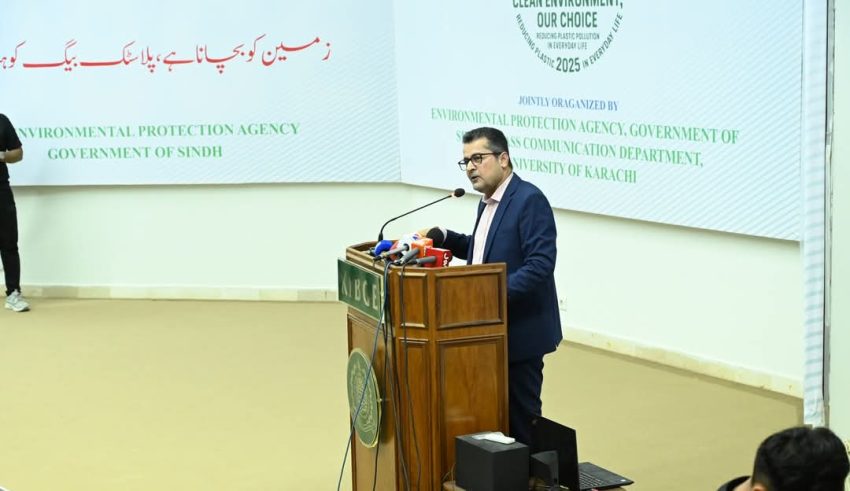
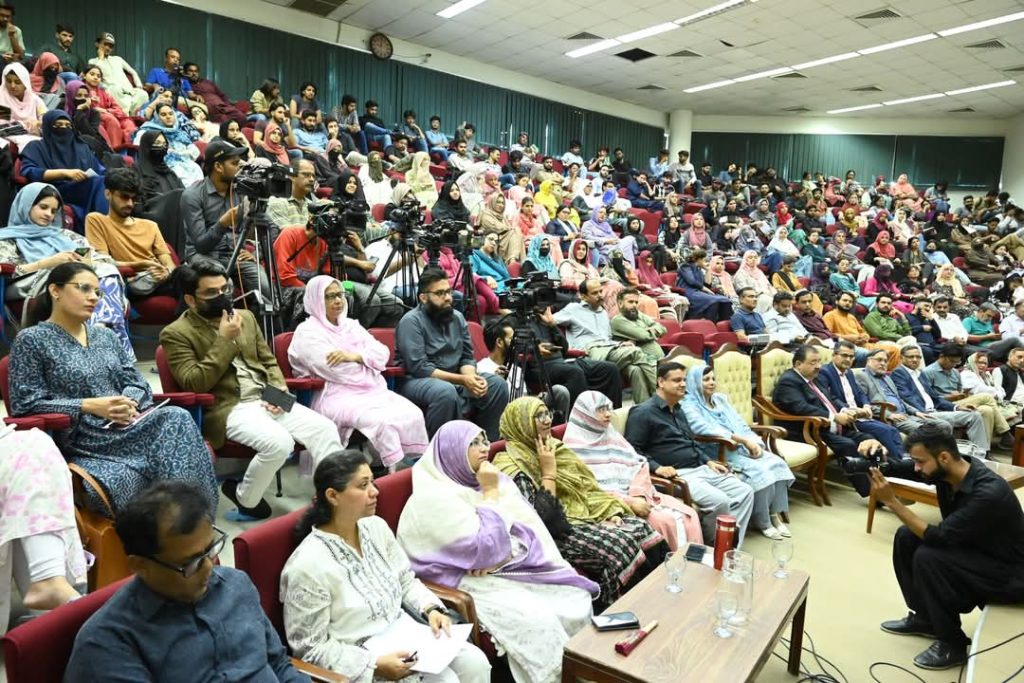
KARACHI: As global temperatures continue to rise and the climate crisis intensifies, stakeholders in Sindh have rallied together to tackle the environmental threat posed by plastic pollution. Marking World Environment Day, the Sindh Environmental Protection Agency (SEPA) and the Department of Mass Communication, University of Karachi (KU), hosted a high-level seminar titled “Reducing Plastic Pollution” at the Dr. A.Q. Khan Institute of Biotechnology & Genetic Engineering.
In his keynote address, Vice Chancellor of KU, Professor Dr. Khalid Mahmood Iraqi, declared climate change to be “not just a global concern, but an urgent crisis in the Pakistani context.” He warned that rising temperatures, melting glaciers, and erratic rainfall patterns are rapidly shrinking Pakistan’s water availability.
“This is not merely a shift in climate — it’s a warning. If we fail to act now, regret will be our only companion in the near future,” he cautioned.
Dr. Iraqi emphasized the need for a cultural and structural shift away from plastic usage, stating that 98% of single-use plastic bags are non-biodegradable and unrecyclable.
“Eliminating access to plastic at shops and markets is essential. Alternatives must be affordable and easily available. We must build awareness, not just temporarily, but as a continuous campaign.”
Complete Ban on Plastic Bags from June 15: Sindh Government Sindh’s Secretary of Environment, Climate Change, and Coastal Development, Agha Shah Nawaz Khan, announced that a province-wide ban on all forms of plastic bags will take effect from June 15, following a policy decision taken earlier in March.
“Plastic shopping bags are not only an environmental hazard, but they also wreak havoc on our sewerage systems. A province-wide crackdown will begin mid-June, starting with major cities like Karachi, Hyderabad, Mirpurkhas, and Larkana,” he said.
Khan revealed that extensive consultations with all stakeholders had been conducted to ensure the policy’s effective implementation.
“Plastic pollution is a global crisis. Eleven million tonnes of plastic enter the environment annually, contaminating soil, water, and food. We must promote a circular economy and environmentally friendly alternatives,” he added.
“Public Support Will Be Key to Success” — SEPA DG
Waqar Hussain Phulpoto, Director General of SEPA, stressed that enforcement of the ban will be coupled with a vigorous public awareness campaign.
“The first phase gave industries time to develop alternatives. Now, enforcement begins. From community engagement to legal implementation, we are taking every step to make Sindh plastic-free,” he asserted.
He urged citizens to replace plastic carriers with cloth bags and noted that SEPA is actively promoting the “No Plastic Carrier Bags” policy.
“Reducing not just plastic bags, but bottles as well, is essential. We appeal to all sectors to support our mission of creating a cleaner, greener, and more sustainable Sindh.”
Phulpoto also noted that educational institutions play a vital role in awareness-raising, highlighting SEPA’s ongoing collaboration with universities to organize environmental campaigns.
“Environmental Protection is a Social Duty”
Professor Dr. Samina Saeed, Dean of Arts and Social Sciences at KU, underscored the societal dimensions of environmental responsibility.
“This isn’t just a scientific or technological issue—it’s a moral and social obligation. We must educate communities, empower local groups, and foster a culture of care that transcends generations.”
Dr. Saeed reminded the audience that World Environment Day is a call to action for every individual, irrespective of profession or background.
“It’s a moment to commit to a future where development and sustainability walk hand-in-hand.”
Tree Plantation, Not Just Policy Talk
Dr. Asmat Ara, Chairperson of the Mass Communication Department, highlighted the rising temperatures in Sindh and Karachi as clear consequences of climate change.
“Immediate action is the need of the hour. Our department has already planted over 4,000 trees on campus in collaboration with WWF,” she shared, underscoring the importance of translating awareness into tangible steps.
“Unresearched Decisions Threaten Urban Ecology”
Professor Dr. Jamil Hasan Kazmi, former chair of KU’s Geography Department, pointed out flaws in urban environmental planning.
“It’s not just plastics—poorly researched decisions like introducing non-native ornamental plants into Karachi’s ecosystem can have lasting negative effects,” he said.
The seminar served not only as a platform for dialogue but as a resolute declaration: Sindh is ready to turn the tide against plastic pollution. But the success of this mission, as echoed by every speaker, hinges not on policy alone — but on public participation, awareness, and collective commitment.