By Rafiq Vayani
DUBAI: The second Baku International Arts Festival (BIAF) will take place in Baku from 28 October to 8 November 2026. Supported by the Heydar Aliyev Foundation and the Ministry of Culture of the Republic of Azerbaijan, the festival spans dance, drama, music, and film across more than 20 events, bringing together artists and ensembles from Azerbaijan, the United Kingdom, Israel, Canada, Monaco, Russia, the United States, France, and other nations.
This year’s programme places special emphasis on collaboration between internationally renowned artists and Azerbaijani performers and institutions, including the Baku Choreography Academy, the Azerbaijan State Academic Opera and Ballet Theatre, the Baku Music Academy, the Azerbaijan State University of Culture and Arts, and the Azerbaijan State Symphony and Chamber Orchestras. Venues include the Muslim Magomayev Azerbaijan State Academic Philharmonic Hall, the Azerbaijan National Drama Theatre, the Heydar Aliyev Center, the Azerbaijan State Musical Theatre, the Heydar Aliyev Palace, the Museum of Stone Chronicle, and Icherisheher (Baku Old City).
BIAF opens on 28 October at the Philharmonic Hall with a concert marking the 120th anniversary of Dmitri Shostakovich, whose life and legacy remain closely tied to Azerbaijan and directly shaped its national school of composition. His Concerto No. 1 for Piano, Trumpet and Orchestra, premiered on this same stage by the composer in 1934, will be performed by Lukas Geniušas, one of the most technically brilliant and artistically interesting pianists of our time, and Norwegian trumpeter Tine Thing Helseth, with the Baku State Chamber Orchestra and the BIAF Festival Orchestra under Baku-born violinist and conductor Dmitry Sitkovetsky.
On 30 October, South African artist William Kentridge’s multimedia work Oh To Believe in Another World brings a live visual interpretation to Shostakovich’s Symphony No. 10, a work whose musical themes encode the composer’s secret declaration of affection for his Baku student, pianist and composer Elmira Nazirova.
Sitkovetsky conducts the Festival Orchestra, and the programme continues with Fikret Amirov and Nazirova’s Concerto for Piano and Orchestra on Arabian Themes, performed by Farhad Badalbeyli, Rector of the Baku Music Academy and a personal acquaintance of both composers.
On 4 November, the Heydar Aliyev Center hosts violinist David Garrett, the Juilliard-trained “Paganini of pop,” presenting his Baku premiere of Millennium Symphony, a symphonic reimagining of the past 25 years’ biggest hits. The festival closes on 8 November at the Philharmonic with two-time Grammy winner Maxim Vengerov, one of the world’s most sought-after violinists.
Theatre opens with Lev Dodin’s acclaimed staging of Chekhov’s The Seagull, from the Maly Drama Theatre – Theatre of Europe (St Petersburg), on 29–30 October at the Musical Theatre. On 1–2 November, Tel Aviv’s Gesher Theatre presents Dmitry Krymov’s Bloody Mary, a free, image-driven response to Schiller’s Mary Stuart. On 3–4 November, the Heydar Aliyev Center welcomes the Rezo Gabriadze Marionette Theatre’s Alfred and Violetta, a reworking of La Dame aux Camélias relocated to 1990s Tbilisi, completed by director Leo Gabriadze after his father’s death in 2021.
The dance programme opens 31 October–1 November with Thikra: Night of Remembering at the National Drama Theatre, choreographed by Akram Khan with visual design by Saudi artist Manal AlDowayan, a piece rooted in ritual remembrance that premiered at AlUla’s Wadi AlFann in 2025. On 5–6 November, choreographer Shahar Binyamini, a Batsheva alumnus who works with the Paris Opera Ballet and La Scala, presents New Earth and Bolero X with his House of Dance Company; as part of the festival’s mentorship strand, Binyamini is also training and integrating dancers from the Azerbaijan State Academic Opera and Ballet Theatre and the Baku Choreography Academy into the production.
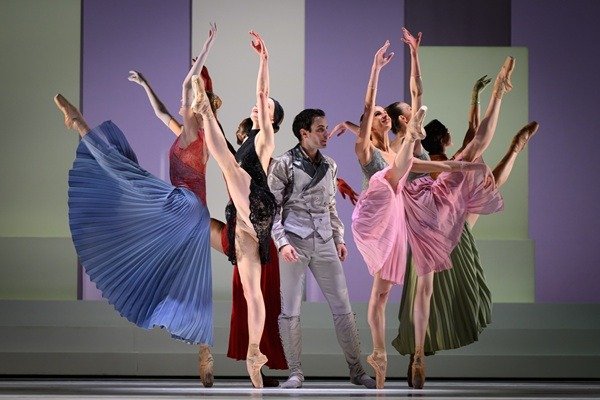
English National Ballet makes its Baku debut on 6–7 November at the Musical Theatre with Masters in Motion: Forsythe/Pite, pairing Crystal Pite’s Body and Soul (Part 1) with William Forsythe’s Playlist (EP). On 7 November, Les Ballets de Monte-Carlo, heirs to Diaghilev’s Ballets Russes, bring their Baku premiere of Jean-Christophe Maillot’s LAC to the Heydar Aliyev Palace, a psychologically charged reimagining of Swan Lake marking 150 years since Tchaikovsky’s original.
The parallel programme includes a rare glimpse of work in progress from choreographer Sharon Eyal on 1 November, and Romeo Castellucci and Scott Gibbons’ sound-based piece To Carthage Then I Came at the Museum of Stone Chronicle on 6–7 November, restaged for the former power station after its Brussels premiere. Public talks bring audiences together with Akram Khan, Manal AlDowayan, Lev Dodin, and others, including historian Peter Frankopan, author of the bestselling The Silk Roads: A New History of the World, in a conversation on Baku’s renewed place at the crossroads of world culture.
BIAF’s second edition follows a successful debut in 2025, which presented more than 20 events and 100 artists from Azerbaijan, Austria, the UK, Germany, Israel, Spain, Canada, China, the US, France, Uzbekistan, and beyond, including works by Robert Lepage, Guillaume Côté, Sharon Eyal, Yang Liping, Rimas Tuminas, and Daniele Finzi Pasca. Modelled on the world’s leading festival platforms, BIAF positions Baku, a historic crossroads of the Silk Road, as a modern, open, multi-genre cultural capital bridging East and West. The opportunity to witness the best stage performances of recent years at the Baku International Arts Festival offers a wonderful reason to visit Azerbaijan and discover its rich history and diverse cultural traditions.
rafiq@biztoday.news