
Workshop at Regional Da’wah Centre Sindh Attended by Journalists and Mass Communication Students
KARACHI: Speakers at a three-day training workshop for journalists and media professionals emphasized that the rise of social media and digital platforms has significantly increased the responsibilities of journalists. With an overwhelming flow of information and news, they said, the challenge lies in identifying and reporting the truth. They noted that Islam provides comprehensive guidance regarding the ethical handling of information and news.
The speakers urged journalists and media students to keep pace with modern requirements, adopt a cautious and responsible approach, and remain conscious of the impact their work has on society. The workshop featured discussions, lectures, and interactive sessions by media professionals, academics, and intellectuals, attended by journalists from various cities of Sindh as well as students of the Department of Mass Communication, University of Karachi.
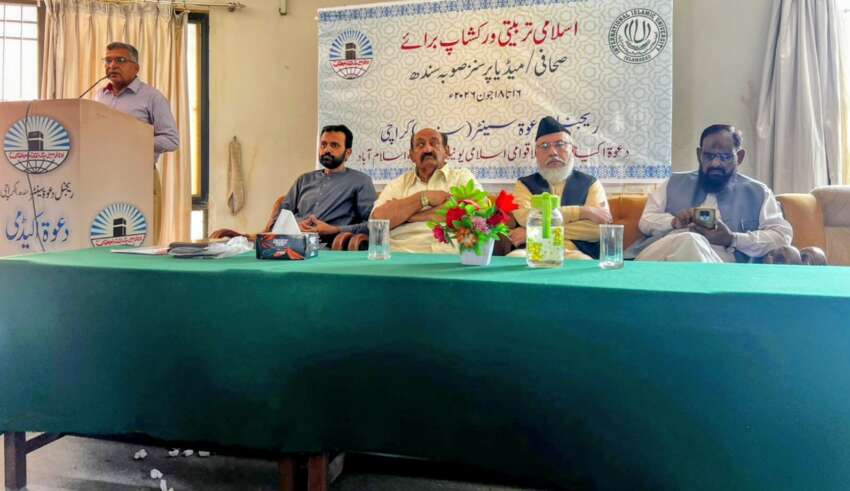
The three-day Islamic Training Programme for Journalists and Media Persons of Sindh was organized by the Da’wah Academy, International Islamic University Islamabad, at the Regional Da’wah Centre Sindh, Karachi.
Programme Coordinator and Assistant Professor Dr. Shehzad Channa introduced the institution and highlighted its year-round training initiatives. He explained that the Centre regularly conducts free training programmes for professionals, students, and members of the public, including both men and women.
Addressing the participants, the Centre’s In-charge, Assistant Professor Dr. Syed Aziz-ur-Rehman, spoke on the significance of the Holy Quran and its practical application in everyday life. He said that the teachings of the Quran provide complete guidance not only for personal conduct but also for the ethical discharge of journalistic responsibilities.
Speaking on leadership in the media, Nisar Musa Baloch said that true leadership cannot emerge without passion, commitment, curiosity, and perseverance. Referring to the vision and lifelong dedication of renowned humanitarian Dr. Adeeb Rizvi, he highlighted the qualities of genuine leadership. He also drew a distinction between vloggers and journalists, stating that while vloggers often focus on views and likes, journalists are responsible for uncovering the truth and guiding their audiences.
The second day commenced with a session titled “Journalistic Values and Our Attitudes” by Tasneem-ul-Haq Farooqi. He emphasized the importance of reading, continuous learning, and the effective use of Artificial Intelligence (AI) to make work easier and more efficient. He observed that learning something new often requires unlearning outdated practices and knowing how to apply knowledge at the right time.
In another session on “Seerah and Journalism,” Dr. Syed Aziz-ur-Rehman stressed that Muslims must never forget the importance of verifying information before sharing it. He remarked that this world is a place of trial rather than reward, and individuals should continue striving to do good regardless of circumstances.
Faisal Shehzad, Editor of Bachon Ka Salam, spoke on the sanctity of the pen and its modern implications. He noted that keyboards, touchscreens, and digital platforms have largely replaced the traditional pen, making it even more important to ensure that sensationalism does not create unrest or social discord. He said safeguarding the dignity and responsibility of communication remains a fundamental duty of journalists. He also urged media professionals to continually enhance their intellectual and professional capacities.
The final session of the second day, titled “Media and Propaganda,” was conducted by Professor Saleem Mughal. He elaborated on the meaning, methods, and objectives of propaganda, discussing its political, diplomatic, and social dimensions. During his talk, he cited the inclusion of the Urdu word “Jugaad” in the Oxford Dictionary, noting that new words become part of a language not through experts alone but through widespread acceptance by ordinary speakers.
The third day began with a panel discussion on “Social Media, Challenges and Precautions.” Senior journalist Azmat Ali Rahmani urged journalists to be fully aware of their rights and to carefully study the Journalists Protection Act. He emphasized that balanced reporting requires presenting the viewpoints of all parties involved in a story.
Former Director of the Department of Mass Communication at the University of Sindh, Jamshoro, Dr. Badr Soomro, told participants that social media has increasingly become a tool of exploitation. While regulations are gradually bringing positive changes, he stressed that meaningful transformation ultimately depends on adopting a responsible social attitude.
Speaking on responsible reporting, Dr. Mahmood Ghaznavi advised journalists to ask themselves whether a story might contribute to social unrest before publishing it. He observed that the media often misunderstands the true meaning of “breaking news” and appears increasingly focused on sensationalism.
Discussing contemporary journalistic challenges, Dr. Ghulam Mustafa Solangi, Senior Producer at PTV Karachi, said the world is rapidly changing and the role of traditional newspapers is becoming more limited. He described social media and digital platforms as necessities of the modern age, carrying both influence and challenges. In societies like Pakistan, he said, these developments represent a significant test. While innovation brings new opportunities, it also presents difficulties that require careful consideration and adaptation.
Participants appreciated the initiative taken by the Regional Da’wah Centre Sindh and described the workshop as a valuable contribution to professional development. They also expressed the hope that similar programmes would continue to be organized in the future.