
KARACHI: The Businessmen Panel (BMP) on Saturday issued a unified business community’s response to the Federal Budget 2026–27, warning that the current fiscal framework places an unsustainable burden on documented filers and threatens to trigger industrial shutdowns across the country.
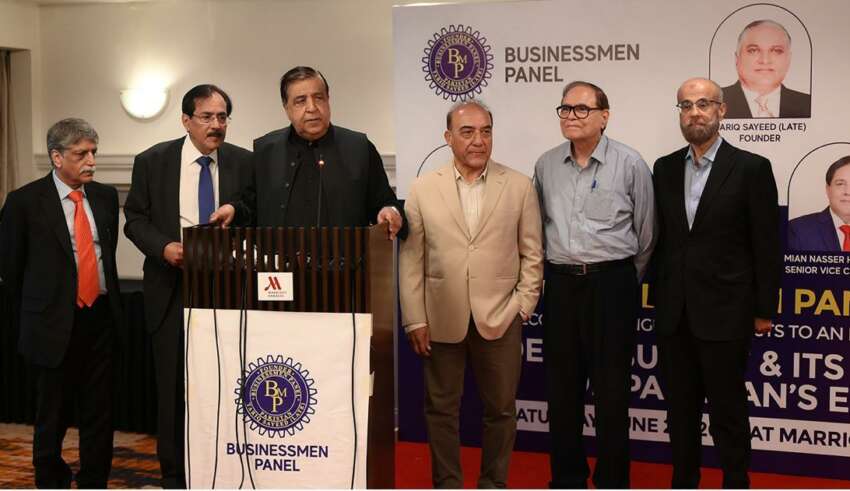
The declaration was made during a high-profile seminar titled “Federal Budget & Its Implications for Pakistan’s Economy,” held at the Marriott Hotel, Karachi. The event drew prominent corporate leaders, trade representatives, and manufacturers from across the country to draft an actionable policy memorandum for the Federal Ministry of Finance and the Federal Board of Revenue (FBR).
In his opening remarks, Sheikh Sultan Rehman, set a sharp agenda for the day, highlighting that while macroeconomic stabilization is necessary, it must not come at the expense of industrial collapse. “We are operating in an environment defined by tight IMF mandates and aggressive revenue targets,” Rehman stated.
Detailing the severe operational impediments hitting the industrial sector, Engineer M.A. Jabbar delivered an analysis focused on the escalating cost of production. He cautioned that increasing primary energy tariffs, coupled with historically high borrowing costs, have crippled Pakistan’s regional manufacturing edge. “The industrial squeeze is real. We need an immediate, predictable ceiling on electricity and gas tariffs alongside custom duty exemptions on core industrial raw materials to prevent large-scale capital flight,” Jabbar emphasized.
Shariq Vohra highlighted various initiatives introduced in the Budget to stimulate economic activities and easing the burden on taxpayers. Key measures include rationalisation of income tax slabs for salaried individuals, providing relief particularly to middle-income earners; substantial reductions in withholding taxes on property transactions to support the real estate sector; and a broad tariff rationalisation programme involving lower customs duties, additional customs duties and regulatory duties to enhance industrial competitiveness.
Addressing the compliance and regulatory framework, Zakaria Usman raised serious concerns over the notice-driven amendments in the Finance Act 2026–27, compounded by recent FBR directives that aggressively target existing filers at the expense of economic growth itself. While affirming business community’s commitment to a documented economy, Usman strongly criticized the expansion of discretionary powers given to the field audit officers.
“Widening the tax net should mean bringing new sectors into the loop, not relentlessly squeezing existing filers with arbitrary audit criteria and delayed sales tax refund cycles,” he stated. He further emphasized that economic self-reliance is completely unattainable under an outdated, oppressive, and unjust tax policy enforced by obsolete administrative machinery.
Evaluating the broader macroeconomic picture, Mian Nasser Hyatt Maggo addressed a number of issues and proposed measures to accelerate economic development.
He said that Afghanistan border closure loss of exports of USD 1.5 billion. Top 3 Banks with higher profits should be directed to open their branches in Central Asian countries.
He pointed out that we are sitting on seaport which can serve landlocked countries, but we have no free trade zones where we can store products especially raw materials for re-export (FTZ) to land locked countries. UAE has 7 FTZs which yield several billion dollars in re-exports.
Under the IMF program, Government of Pakistan cannot borrow directly from state bank restricting Government borrowing from commercial banks. This fiscal year domestic borrowing is Rs 7.197 trillion, giving unnecessary advantage of billions of rupees to the commercial banks.
According to IMF, corruption costs 6.4% of GDP. Adoption of AI will eliminate the corruption as less or no human contact will be needed for AI-based systems.
Pakistan’s 2 provinces are undergoing security issues and have faced floods costing Rs 220 billion so in a situation where we have limited taxpayers, government cannot be run properly. Most of the unregistered businesses don’t want to come into the tax regime due to mistrust and scoff laws which leads to corruption so need of the hour is implement fixed tax regime like the UAE, to give economy a boost and instill confidence among the medium and small businesses.
Maggo emphasized the urgent need to create a stable, high-growth environment capable of pulling back the “hot money” and domestic capital that fled due to systemic mistrust. “Our economic development cannot be sustained when Foreign Direct Investment (FDI) is restricted to a meager US$ 1.5 Billion annually, while over US$ 2 Billion is simultaneously being repatriated out of the country as corporate profits,” Maggo cautioned. He also advocated for a progressive, facilitating regulatory framework to localize and formalize the massive crypto economy currently held by Pakistani citizens.
Maggo further pointed out that Pakistan is trapped in a dilemma of dangerously low savings rates and an inadequate investment-to-GDP ratio. This structural flaw has forced the country into a vicious cycle where borrowing new loans to service old debt has become the standard economic management framework. “An economic growth rate of less than 4% cannot heal the deep structural wounds of a nation where 40% of the population languishes below the poverty line,” he stated.
He advised the government: “With potential U.S. waivers for Iran on the horizon, Pakistan must immediately do the groundwork to link the Central Bank of Iran with the State Bank of Pakistan. We need to formalize barter and currency-swapping mechanisms to unlock border trade in the mutual interest of both nations.”
Furthermore, to restore trust between the state and the business community, Maggo strongly demanded that the government legislate a comprehensive Taxpayers’ Bill of Rights. This framework must guarantee legally enforceable rights to timely tax refunds, absolute privacy, fair treatment, due process in appeals, and an immediate prohibition on coercive asset recoveries while tax litigation remains pending before courts or appellate forums.
Following a passionate open house debate, the session concluded with a formal vote of thanks by Suleman Chawla, who presented the Karachi Declaration – a memorandum passed by consensus.
During the interactive open house discussion, various business leaders registered their strong reservations regarding specific budgetary measures adversely affecting business environment.