

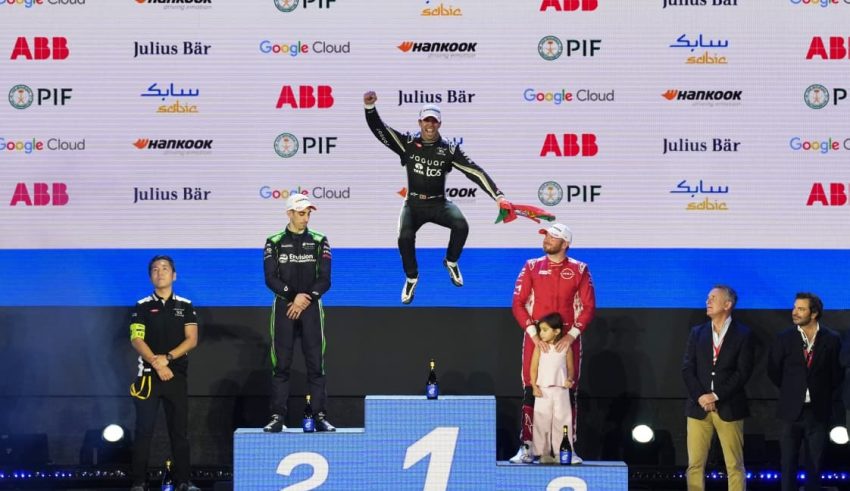
In most disciplines of motorsport, innovation is driven by budget and freedom to experiment. More budget and fewer regulations mean more innovation. The ABB FIA Formula E World Championship, however, is built on fundamentally different logic. Energy usage is strictly regulated, costs are tightly controlled, and sporting rules have been designed to keep the racing as competitive as possible. Formula E treats efficiency and adaptability as defining conditions of success. Every decision is taken under clearly defined limits, often in real time, with no margin for waste.
Rather than impacting progress, this purposeful framework has delivered measurable advances in efficiency; the current all-electric GEN3 Evo race cars competing in Formula E Season 12 are engineered to be among the world’s most efficient race vehicles, with more than 90% electric motor efficiency and advanced energy regeneration systems that can recapture up to 40% of energy across a race distance.
Business or sport: adaptability is key
These outcomes point to a deeper reality. By requiring teams to work within fixed boundaries, Formula E has become one of the most fruitful environments for innovation in modern sport. It functions as a live experiment in extracting maximum performance from finite resources, where success is defined by intelligence. That dynamic increasingly mirrors the conditions businesses face today, where growth is shaped by a rapidly evolving global landscape.
Formula E drives teams to make sharper and faster choices under pressure. That very same discipline is required by organisations as they navigate regulations, sustainability targets, cost controls, and accelerating technological changes. Also, in today’s geo-political environment businesses must constantly evolve and adapt accordingly to secure sustainable economic growth.
A validation model driving Jaguar TCS Racing
Nowhere is this pressure more visible than in the challenge of vehicle testing. Formula E races often take place on temporary street circuits across global cities, leaving reduced scope for traditional track time and testing. Yet teams must still develop cars capable of competing at the highest level. For Jaguar TCS Racing, this raised a fundamental question: could a vehicle’s on-track behaviour be accurately replicated in a simulated environment, and could that simulation be trusted to guide last-minute performance decisions?
Answering that question sits at the heart of the partnership between Tata Consultancy Services (TCS) and Jaguar TCS Racing. Working alongside the team, TCS enhances the digital twin technology underpinning Jaguar TCS Racing’s preparation and development processes. This collaboration led to the creation of the Virtual Vehicle Validation Model (V3M), a mathematical framework designed to guide the digital twin of the Jaguar I-TYPE 7 using multiple real-world inputs.
The V3M allows continuous simulations to run without human intervention, rapidly validating software changes before deployment This capability is critical in a championship where software adjustments can be made right up until the final moments of a race. The V3M enables engineers to test, refine, and validate changes at speed, saving valuable preparation time and reducing risk on race day. When Jaguar TCS Racing drivers Mitch Evans and António Félix da Costa step into the simulator, they do so with confidence that the data reflects real-world conditions.
TCS Digital Twins: driving Innovation across industries
The same logic increasingly applies beyond the racetrack. In business, digital twins are used to model factories, supply chains, infrastructure, and customer journeys, allowing organisations to predict outcomes, stress-test scenarios, and optimise performance before real-world deployment. Research shows these systems can deliver up to 30% improvements in energy efficiency and operational performance, while more advanced AI-enabled digital twins have demonstrated reductions of up to 35% in unplanned downtime alongside measurable gains in energy optimisation.
Sumanta Roy, President & Regional CEO, Middle East, Africa, TCS says, “The partnership between TCS and Jaguar TCS Racing embodies this mindset, proving that when guided by data, intelligence, and discipline, organisations can unlock extraordinary efficiency and performance. Our work together demonstrates how advanced digital twin technology can transform not just motorsport, but every data‑led organisation. By enabling faster, smarter decision‑making under constraints, we are helping businesses across the region accelerate innovation, reduce risk, and drive sustainable growth. This is the blueprint for businesses navigating the complexities of today’s world.”
Formula E’s tightly regulated environment makes these lessons extremely important. With strict rules around energy, testing, and other factors, the championship rewards teams that can adapt fastest rather than those with the most resources.
Over 11 seasons, the all-electric championship has delivered rapid technological advances. In the current GEN3 Evo era, cars like the Jaguar I-TYPE 7 are now the fastest-accelerating FIA single-seaters in the world as the pinnacle of electric motorsport has continued to evolve and adapt.
Sustainability and performance blend well
Beyond performance, there is also a cultural lesson and mindset shift embedded in Formula E’s model. The championship demonstrates that sustainability and performance are not opposing goals. Working within energy limits influences smarter design, better data usage, and more efficient systems. For business leaders and technologists, it offers a reminder that clearly defined boundaries can accelerate creativity and growth rather than suppress it.
As organisations across industries struggle with regulations, sustainability imperatives, and rapid technological changes, Formula E provides a compelling analogy for the future of innovation. It shows that when resources are finite and the pressure is high, the winners are those who adapt fastest, make resourceful decisions, and trust data-driven insight over intuition alone. On the streets where Formula E races are won and lost, constraint is the catalyst.