
Aalmi Mushaira In the Memory of Benazir Bhutto Captivates the Audience
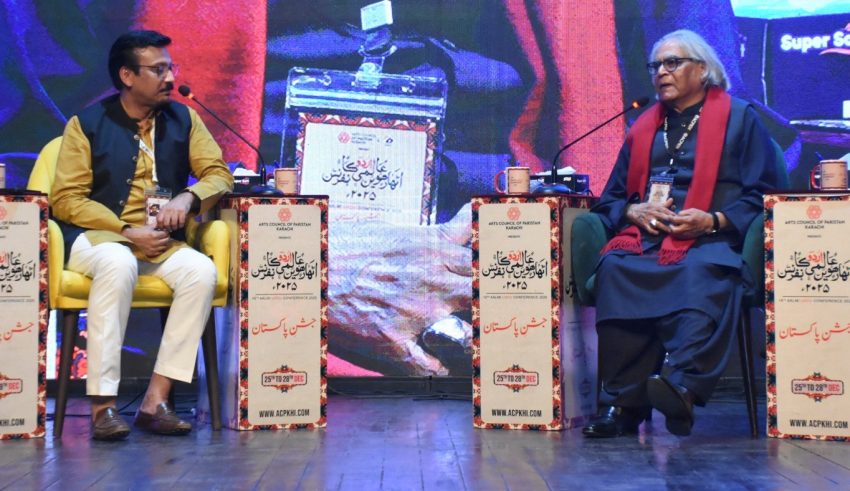
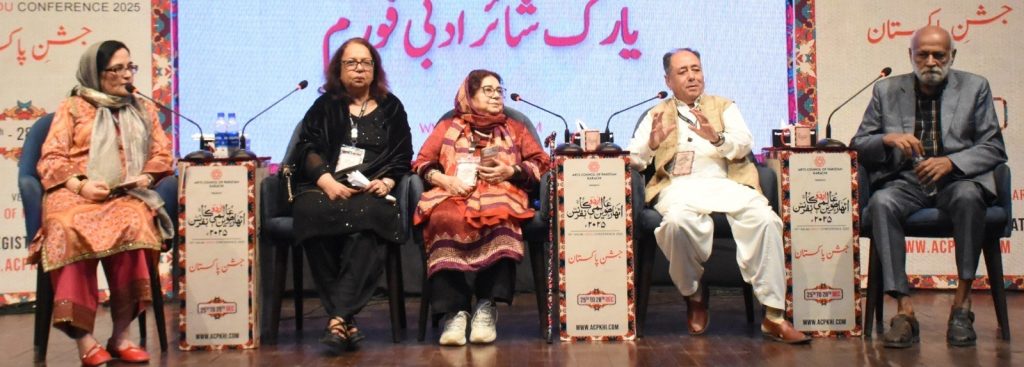
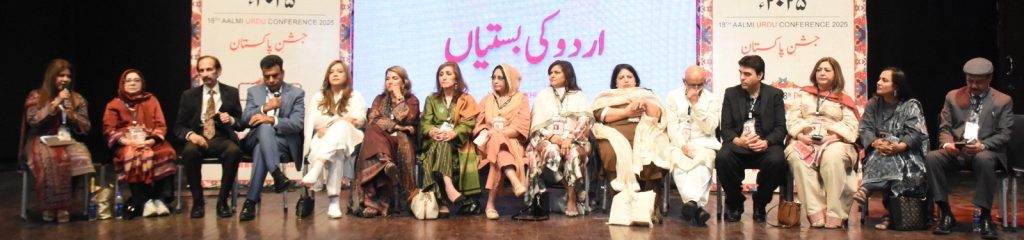
Arts Council of Pakistan Karachi, literary activities remained at their peak on the third day of the four-day 18th Aalmi Urdu Conference 2025 – Jashan-e-Pakistan. A total of 22 sessions were held, including the launch of eight books, sessions with Tehzeeb Hafi and Umair Najmi, and an Aalmi Mushaira in memory of Shaheed Benazir Bhutto. On the third day of the conference, sessions were organized on a wide range of subjects including Urdu Ghazal, Urdu Novel, Yorkshire Adbi Forum, Kitabon ki Runami ,Intizar Hussain ke So Saal, Pashtun Saqafat aur Adab, Punjabi Adab aur Saqafat, Mausmiati Tabdeeli, Pakistan ko Darpaish Buhran, “Khoon Se Jab Jala Diya…”, “Koi To Phool Khilaye” Hamara Taleemi Mayaar, Mausiki ka Safar aur Badalte Rujhanat, Japan mein Urdu, Yaad-e-Raftgaan, Urdu ki Bastiyan, Kashmir ka Muzahmati Adab, “Bazeecha-e-Atfal Hai Duniya Mere Aage” (Jashan Salgirah), Film ka Safar, and “Mitti Mein Chiragh Rakh Diya Hai”, Jaun aur Main. Aalmi Mushaira in memory of Shaheed Benazir Bhutto.
During the Urdu Conference, Pirzada Salman’s theatre play “Jaun Aur Main” was presented, which became the center of attention for the audience. The play revolved around the mysterious personality of the great Urdu poet Jaun Elia, highlighting that no matter how deeply one tries to understand a creative individual, their personality always remains partly unknown. The audience highly appreciated the short yet powerful play and applauded enthusiastically.
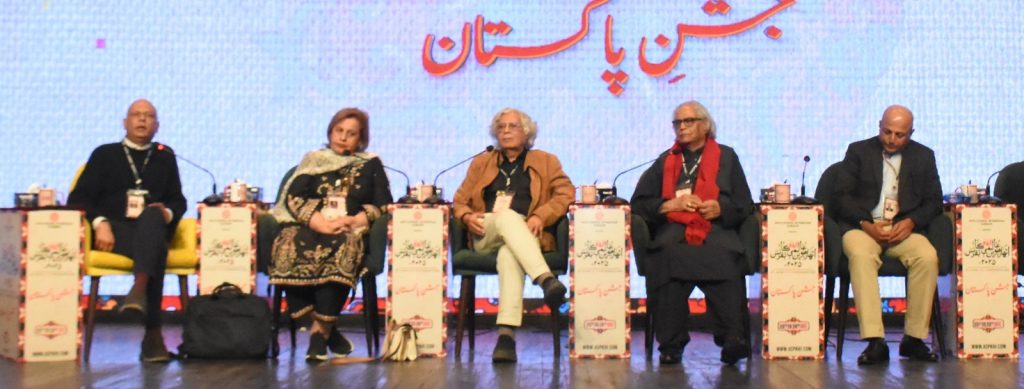
In the session “Bazeecha-e-Atfal Hai Duniya Mere Aage”, organized in connection with the birth anniversary of Mirza Ghalib, Firasat Rizvi said that reports against Ghalib still exist in the Delhi Museum. He stated that Mirza Ghalib spent his entire life struggling against his era. Many objections were raised against him during his lifetime, some of which were justified, but those objections ultimately contributed to Ghalib’s literary growth. He further said that Ghalib did not write poetry after the age of 43 and that his ego was, at places, unnatural.
In the session “Koi To Phool Khilaye”, Senator Faisal Subzwari held a conversation with Iftikhar Arif. Faisal Subzwari welcomed Iftikhar Arif by reciting verses, to which Iftikhar Arif expressed his gratitude and said that he began his journey with poetry and later served at Radio Pakistan. He shared that a poem he wrote during his stay in London became extraordinarily popular. He said migration is not merely a change of place but a journey toward the fulfillment of higher goals and bigger dreams, which deeply influence human thought and creativity.
In the session on Punjabi Literature and Culture, Sarwat Mohiuddin, Zia-ul-Hassan, Rakhshanda Naveed, and Bina Goindi paid tribute to prominent Punjabi and revolutionary literary figures including Shiv Kumar Batalvi, Amrita Pritam, Mohan Singh, Sharif Kunjahi, Ustad Daman, Habib Jalib, Mansha Yaad, Afzal Ahsan Randhawa, Nasreen Anjum Bhatti, Ahmed Saleem, Sain Akhtar Hussain Lahori, Afzal Tauseef, Sufi Tabassum, Shafee Aqeel, and others.
In the session “Mausmiati Tabdeeli, Pakistan ko Darpaish Buhran”, Afia Salam, Sameen Kamal, Rafi-ul-Haq, and Tariq Qaiser highlighted various environmental issues. The speakers said that Pakistan’s water crisis is the result of administrative failure and an inefficient drainage system. They warned that falsehood spreads rapidly while truth takes time to reach people, which is the biggest danger. They also stressed that the lack of environmental education and geography training in schools has left the younger generation incapable of understanding the severity of the crisis.
In the session “Musiki ka Safar aur badalta Rohjanay”, renowned musicians and singers Arshad Mahmood, Tina Sani, Shareef Awan, Salman Alvi, and Azhar Hussain shared their views on different aspects of music, while Amjad Shah performed the duties of moderator. Participants expressed regret that Pakistani artists do not receive the appreciation they deserve at the local level. Shareef Awan cited examples of Nusrat Fateh Ali Khan and Ustad Nisar Bazmi, stating that the tradition of acknowledging artists’ contributions has weakened, forcing many talented individuals to leave the country. Salman Alvi highlighted the role of television, saying that in the past films succeeded mainly due to music, and television introduced singers like Alamgir, Muhammad Ali Shehki, and Sajjad Ali to the masses. Tina Sani recalled the early creative environment where senior artists and young singers worked under one roof, enabling direct learning. Azhar Hussain said that the arrival of Nisar Bazmi and Nashad transformed musical styles and connected Pakistani music with global standards. Arshad Mahmood said that tradition is not static but evolves through gatherings and creative forums, and that music is not merely entertainment but a source of social and intellectual awareness.
In the session “Hamara Taleemi Mayar”, Tariq Rafi, Sadiqa Salahuddin, Surosh Lodhi, Mujeeb Seharai, Yousuf Khushk, Asif Sheikh, and Wahida Mehsar discussed the declining education system. Speakers said that the educational standard is rapidly deteriorating, and efforts are being made to improve it. They remarked that a society which considers a primary school teacher insignificant cannot progress. Sadiqa Salahuddin said that although new schools have been built and teachers recruited, it remains to be seen whether these steps will yield positive results. Tariq Rafi stated that if the country’s economy were strong, children would not feel compelled to go abroad. He pointed out that Punjab has double the number of universities compared to Sindh but receives only Rs15 billion, while Sindh receives Rs50 billion for universities from the provincial government, and Khyber Pakhtunkhwa receives only Rs 2 billion. Wahida Mehsar said that when people fail to find jobs, they are often told to join the teaching profession.
In the session on “Kashmir ka Mazahmati Adab”, Zia-ul-Hassan and Bashir Sadozai provided intellectual and literary insights, opening new perspectives on history, politics, and social consciousness.
In “Nui Nasal ki Numainda Awazain”, the poetry of Tehzeeb Hafi and Umair Najmi received great appreciation from the audience.
In the session “Film ka Safar”, renowned actors Javed Sheikh, Shehryar Munawar, Mustafa Qureshi, Munawar Saeed, and acclaimed director Nabeel Qureshi shed light on the journey of cinema. Tributes were paid to legendary figures of Pakistan’s film industry including Pervez Malik, Waheed Murad, Muhammad Ali, Hassan Tariq, Neelo, Ijaz, A. Salman, Darpan, Santosh Kumar, Inayat Hussain Bhatti, Nazar Shabab, Munawar Zarif, Yunus Malik, Altaf Hussain, Sarwar Bhatti, Shabab Kiranvi, Shaukat Hussain, and Bari Malik.
A special session titled “Mitti Mein Chiragh Rakh Diya Hai” was held in memory of Shaheed Benazir Bhutto, the first female Prime Minister of Pakistan and the Muslim world. Speakers said that Pakistan’s political history has seen two women who began their political journeys through resistance: Mohtarma Fatima Jinnah and Mohtarma Benazir Bhutto. Noor-ul-Huda Shah said that there is a clear difference between a politician and a true leader, and that a real leader is deeply connected to the people and the land. She said Benazir Bhutto emerged from this very soil and remained connected to it until her last breath. Iftikhar Arif said that Benazir Bhutto was a well-read, dignified woman of strong character and that she continues to be held in great respect. Participants unanimously agreed that the love and devotion Benazir Bhutto received from the people of Sindh was unparalleled.
The third day concluded with an Aalmi Mushaira in memory of Shaheed Benazir Bhutto, presided over by renowned poet Iftikhar Arif. Poets including Khursheed Rizvi, Sabir Zafar, Shahida Hasan, Afzal Ahmed Syed, Khalid Irfan, Basir Kazmi, Qamar Raza Shahzad, Fatima Hasan, Javed Saba, Hamida Shaheen, Shakeel Jazib, Aqeel Abbas Jafri, Nasira Zubairi, Sarwat Zahra, Wasi Shah, Iqbal Pirzada, Haris Khaliq, Rakhshanda Naveed, Fariha Naqvi, Tehzeeb Hafi, Rehman Faris, Ghazanfar Hashmi, Tehmina Rao, Imran Aami, Pirzada Salman, Shabbir Nazish, Salman Sarwat, Seeman Naveed, and Yasmeen Yas paid tribute to Shaheed Benazir Bhutto through their poetry on her death anniversary.